
What weight oil for a diesel engine?
Most diesel engines use a 15W-40 or 5W-40 oil, but the right weight depends on your engine and the temperatures you drive in. The first number (5W or 15W) describes how easily the oil flows when cold. The lower it is, the faster it reaches engine parts on a cold start. The second number (40) describes its thickness at operating temperature.
15W-40
Moderate to warm climates, older and heavy-duty diesels
The long-time standard. Thicker when cold.
5W-40
Cold climates and frequent cold starts
Usually synthetic. Flows faster below freezing.
10W-30
Engines that list it as an option
Often allowed for colder weather or better fuel economy.
Lower grades
Only engines that specify them, often with an OEM approval
Such as 5W-30 or 0W-30. Do not substitute without checking the manual.
In Fort Collins, winter mornings regularly drop below freezing. If your manual allows it, a 5W-40 synthetic gives the engine faster oil flow on those cold starts. A block heater helps too.
API ratings: CK-4, FA-4, and what's coming in 2027
The American Petroleum Institute (API) rates diesel engine oils by performance category. The category is printed on every qualifying jug.
2006
CJ-4
Obsolete. Older articles still recommend it.
December 2016, current
CK-4 and FA-4
CK-4 is backward compatible. FA-4 is only for engines designed for it.
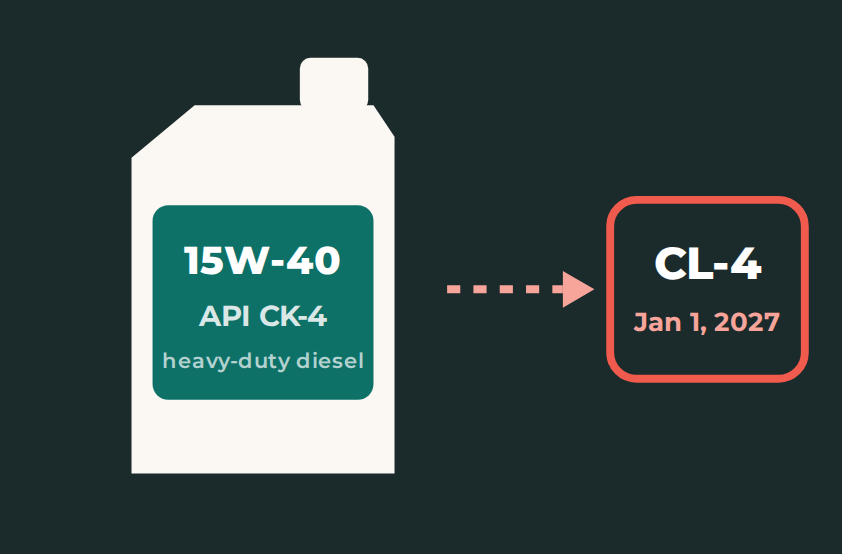
January 1, 2027
CL-4 and FB-4
CL-4 replaces CK-4 and stays backward compatible. FB-4 replaces FA-4.
If you have a jug of CJ-4 on the shelf, CK-4 is the modern equivalent. When CL-4 arrives, it is designed to work in engines that call for CK-4.
Check for an OEM approval
Many diesel engines need more than an API rating. Light-duty diesels in pickups, SUVs, and European cars often require a specific manufacturer approval, such as GM dexosD or a Volkswagen 507.00 rating. Heavy-duty engines may list a Cummins, Ford, or Detroit specification. The approval is printed on qualifying oil jugs and in your owner's manual.
Not sure which oil your diesel needs? We'll look up the spec.
Book a diesel oil changeSynthetic vs. conventional diesel oil
Synthetic diesel oil resists heat breakdown better, flows faster in cold weather, and often holds up longer between changes. Conventional diesel oil costs less and works well in many older engines under moderate use. Synthetic blends sit in between.
For trucks that tow, haul, idle for long periods, or start in cold weather, synthetic is usually worth the extra cost. Whatever you choose, follow the interval in your owner's manual. Extend it only with oil analysis to back it up.
Why diesel oil is different
Diesel engine oil carries heavier additive packages than gasoline engine oil, because diesels produce more soot and run higher compression. Those additives help control:
Soot, which thickens oil and wears parts.
Oxidation and deposits from high heat, especially in turbocharged engines.
Wear on cams, lifters, and bearings under heavy load.
Ash content, which modern oils limit to protect diesel particulate filters (DPFs).
That last point is why the right category matters on newer diesels. The wrong oil can shorten the life of expensive emissions equipment.
Brands professionals commonly use
Several major diesel oil lines offer CK-4 oils in common weights, including Shell Rotella, Mobil Delvac, Chevron Delo, Valvoline Premium Blue, Castrol, and AMSOIL. Product names and formulas change, so pick by the API category, OEM approval, and viscosity on the label rather than the brand name. Curious about additives? See our BG MOA review.
Diesel oil changes and auto repair in Fort Collins, CO
Community Auto services diesel pickups and SUVs, matching the oil to your engine's spec and your driving, whether that's daily commuting or towing up the canyon. We change the oil and filter, check for leaks, and keep your service history on track.
For dependable auto repair in Fort Collins, call or book online. Learn more about our oil change service.
Frequently asked questions
Can I use 15W-40 instead of 5W-40 in my diesel?
If your manual lists both, yes. In cold weather, 5W-40 reaches engine parts faster on startup, so it is often the better winter choice.
Can I use CK-4 oil in an older diesel?
Yes. CK-4 is backward compatible with engines that called for CJ-4, CI-4, and earlier categories.
Is synthetic oil better for diesel engines?
Synthetic oil handles cold starts and high heat better, which helps engines that tow, idle a lot, or start in freezing weather. Conventional oil is fine for many older engines under light use.
Can I put diesel oil in a gas engine?
Not unless the oil also carries a current gasoline rating your manual accepts. Many diesel oils are not designed for modern gas engines.