
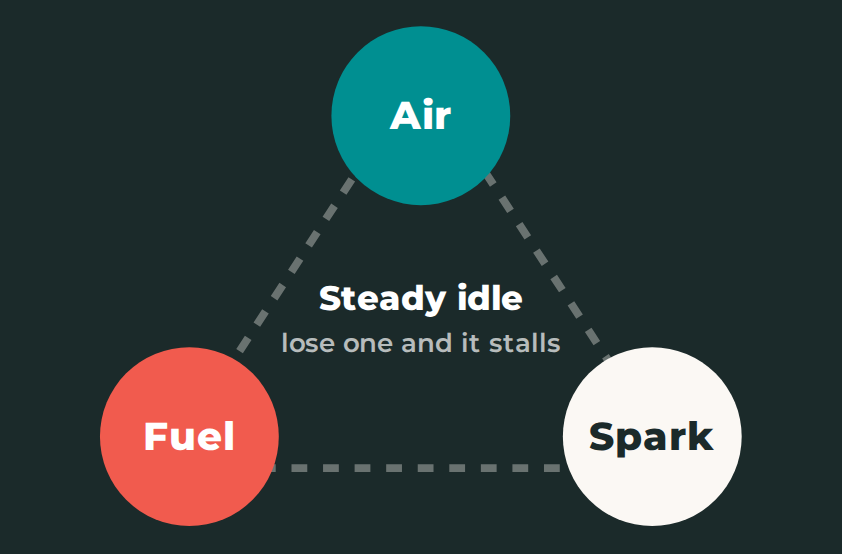
Air problems that make a car stall at idle
Air problems are the most common reason a car stalls at idle, because the engine computer has to meter a very small, precise amount of air to hold a steady idle.
Dirty throttle body or idle air control valve
Older vehicles use an idle air control valve (IACV) to let a measured amount of air around the closed throttle. Most newer vehicles use an electronic throttle body that does the same job. Either one can get coated in carbon, which restricts airflow and causes a rough, dropping idle that ends in a stall. Cleaning often fixes it. Some vehicles need an idle relearn afterward.
Vacuum leaks
A cracked vacuum hose, a leaking intake gasket, or a failed PCV valve lets in air the engine computer cannot measure. That throws off the air-fuel ratio and can cause a high or hunting idle, a rough idle, or a stall. A hissing sound under the hood is a common clue.
Dirty or failing mass airflow (MAF) sensor
The MAF sensor measures how much air enters the engine. When it is dirty, it reports the wrong amount, and the engine runs too lean or too rich. Rough idle, hesitation, and stalling follow. High-mileage cars are especially prone to this.
Fuel problems that cause stalling
Fuel problems cause stalling when the engine cannot get steady fuel pressure at low speed.
A clogged fuel filter that restricts flow.
A weak fuel pump that cannot hold pressure.
Dirty fuel injectors that spray unevenly.
A faulty fuel pressure regulator.
Fuel-related stalling often comes with hard starting or hesitation when you accelerate. Our fuel system service can test pressure and injector flow.
Stalling at stoplights? Let's find out why.
Book a diagnosticIgnition and electrical causes
Ignition and electrical problems make a car stall at idle when the engine loses spark or the computer loses steady voltage.
Worn spark plugs or failing ignition coils cause misfires, which are most noticeable at idle.
A failing alternator or weak battery can let voltage drop when headlights, heater fan, and rear defrost all run at a light.
Loose or corroded battery terminals can cut power for a split second, which is enough to kill the engine.
A sticking EGR valve lets exhaust gas into the intake at idle, which smothers combustion.
When it stalls is a clue
Notice the situation the stall happens in. It points the diagnosis in the right direction.
Only when the engine is cold
Coolant temperature sensor, idle air control, or a vacuum leak.
Only after it is fully warm
EGR valve, fuel pressure, or an ignition coil breaking down with heat.
When you turn on the A/C
A dirty throttle body or idle control can't handle the extra load.
As you coast to a stop
Throttle body, idle control, or the torque converter on an automatic.
With a check engine light
Read the codes first. They usually point the way.
What to do if your car keeps stalling
If your car keeps stalling, have it diagnosed before it leaves you stranded. A stall in traffic means losing power steering and most of your power brake assist, which makes the car much harder to control.
Note when it happens. Cold or warm, A/C on or off, coming to a stop or sitting still.
Check for a warning light. If it's on, see what to do when your check engine light comes on.
Get a proper diagnosis. Our electronic diagnostics read codes and live data instead of guessing.
Check for recalls. Look up your VIN on the NHTSA recall site.
Keep up with maintenance. A tune-up covers filters and spark plugs.
Stalling diagnosis and auto repair in Fort Collins, CO
At Community Auto, we read the codes, look at live engine data, and test the likely parts before recommending a repair. You get a clear explanation of why your car stalls at idle and what it takes to fix it.
For honest auto repair in Fort Collins, call or book online.
Frequently asked questions
Is it dangerous if my car stalls at idle?
It can be. When the engine dies, you lose power steering and most power brake assist, which makes the car harder to steer and stop.
Can a bad battery cause a car to stall at idle?
A weak battery or loose terminal can, especially when the alternator is also struggling. Voltage drops at idle can shut the engine off.
Why does my car stall when I turn on the A/C?
The A/C compressor adds load at idle. A dirty throttle body or failing idle control cannot raise the idle enough to handle it.
Will cleaning the throttle body fix stalling?
It often helps when carbon buildup is the cause. It will not fix a vacuum leak, fuel problem, or bad sensor, so diagnose first.